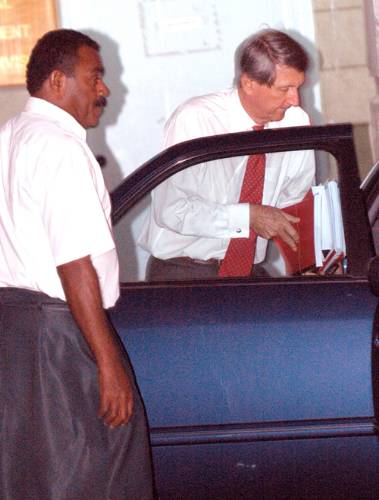
ON Thursday April 10, 2008, during the public debate on the People's Charter organised by the Fiji Media Council, pro-charter and National Council for Building a Better Fiji member Kamlesh Arya, vigorously defended the military.
This is what he said: "First and foremost, the military has sons and daughters of Fiji who have taken the oath to protect Fiji from all adverse situations. It is not ignorant of the law. Their law is one of engagement after all else fails. They are compassionate to the needs of the people. They rise to the occasion when Fiji is faced with calamities and if the military was opportunist then its members would not lay their lives for the nation.
"We need to search deeper than what is on the surface to find out what has been going on since 1987."
But what Arya, the president of Arya Pratinidhi Sabha of Fiji, said while answering a question from the audience totally shifted the blame from the military to certain people in the country for using the armed forces to carry out the coups since 1987.
When asked if coups or elections were more expensive to Fiji, Arya replied: "In my submission this evening (April 10), I said let us not blame the military for the coups. They were the henchmen I must say. They were used to do somebody else's dirty job. Now in 1987 the coup was hyped up as a Fijian issue, right, for the Fijians.
"What did we get, what did the Fijian community get out of the 1987 coup nothing. In 1987 Fijians basically lost everything in terms of respect and dignity because somebody said he was fighting for the rights of the Fijians.
"In 2000 it was an indigenous issue again. What did the Fijian community get nothing. They lost much more. They lost the total dignity of people being able to apply the rule of law. Other communities have continued to stick their necks, stand and contribute to the development of the country each time there is a coup.
"So we have to do deeper soul-searching to find out why the military does, what it has done four times and I don't blame them. They are just there for manipulation by people who have vested interests."
There have been only two political parties in Fiji which have survived or experienced all four coups the National Federation Party, which was in a coalition government with the Fiji Labour Party in 1987, was removed from power by Sitiveni Rabuka in the first coup of May 14, 1987.
While the Labour party has opposed the three previous coups and called for a speedy return to democracy, it has made a complete about-turn and defended the actions of the military since December 2006.
It is therefore prudent to examine Labour's position on the coups in view of Arya's forceful defence of the army. In 2004, the Labour party and National Farmers Union launched Children of the Indus to mark the 125th anniversary of the arrival of indentured labourers to Fiji.
The book's cover had a picture of Chaudhry and his grand-daughter, taken after he and his colleague's release from 56 days of captivity after the 2000 coup.
The book, while describing the late Ratu Mara as a visionary and statesman had scathing remarks about his and the late Ratu Penaia Ganilau's roles in the May 1987 coups.
Page 144 of the book states: "It is clear there was an orchestrated conspiracy to restore power to the Eastern bloc (Lau/Cakaudrove). Rabuka was a favourite with Ratu Penaia who was his high chief. Certain events of that morning (May 14, 1987) arouse suspicion. Was Colonel Sanday deliberately lured to Government House to get him out of the way?
Second, when Speaker Militoni Leweniqila rang Ratu Penaia to inform him of the military takeover, he did not appear surprised. Also when Rabuka shortly after the takeover went to Government House to report the deed, his first words were: "Well sir, I have done it." Curiously enough, the Governor-General's only response was: "I hope you know what you are doing." Was Ratu Penaia in the know-how? It is a legitimate question.
Page 145 & 146 of the book states: "And how much was Ratu Mara in the know about what was to happen? Mara has always denied knowledge about the coup, yet he told the late Robert Keith-Reid, of Islands Business that he received a phone call at the Fijian Hotel at 9am on May 14, 1987 to tell him about the coup. 9am one hour before the coup took place.
Wasn't it his duty to warn Prime Minister Dr Timoci Bavadra, some members of Government or the police of what was about to take place?"
The above was forcefully explained to voters by Chaudhry during the 1992 election campaign who said that by entering Parliament under the 1990 Constitution would mean achieving the final chapter in the chiefs and the Alliance Party's plan to permanently entrench power in the hands of Fijians. Therefore, if Arya is right, Rabuka and the army were manipulated and used as henchmen by Ratu Mara and Ratu Penaia to carry out the 1987 coups. Following the 3rd coup of May 19, 2000, Chaudhry wrote an article in the Parliamentarian, the journal of parliaments of the Commonwealth. He spoke about the army and police in Fiji.
In the article, Chaudhry stated that the security forces posed the biggest threat to the stability of any democratically elected government in Fiji. His article was titled, The aftermath of a coup: Power grabs and destabilisation in Fiji'. He reminded fellow Commonwealth parliamentarians that he had been the victim of three coups in Fiji.
Chaudhry said: "The events of the past two years in particular have shown that neither the police nor the army can be trusted to uphold the Constitution and maintain law and order. No elected government that is not of their choice will ever be safe in this country if this situation is allowed to go unchecked. Indeed, if this situation is allowed to continue, Fiji will simply become another Indonesia where the military has formed an oligarchy with allegedly corrupt politicians and business interests."
Chaudhry claimed the police force had been infiltrated by the army and could no longer be trusted to maintain law and order. Therefore, according to Arya's theory, a unit of the army in 2000 was manipulated and used by corrupt politicians, unscrupulous businessmen and factional groups to topple Chaudhry's government.
But Arya, a Labour party MP for five years between 2001 and 2006 did not say who used the army as henchmen and manipulated them to execute the 2006 coup that removed from power Laisenia Qarase's SDL-led government.
To assist Arya in forming his conclusion, let me remind him of Labour party president Jokapeci Koroi's remarks during Fiji TV's indepth news on January 11, 2006. When asked by a reporter how did the Labour party view Bainimarama's threat to topple government Koroi replied: "I think he should do it because we're waiting, the Labour coalition government, we are waiting to complete what we started in 1999 and 2000. I know a lot of people will disagree with me."
Koroi, while claiming that Bainimarama was being intimidated by the government, said "I am not saying that I support it but you don't know what kind of takeover he is going to do and I have a feeling it's not going to be like the 2000 and 1987 coup, no."
While last minute talks brokered by then Vice-President Ratu Joni Madraiwiwi prevented the stand-off between Qarase and Bainimarama into escalating any further, the coup eventually happened 11 months later on December 5, 2006 after the army's truth and justice campaign failed to prevent the re-election of Qarase and his SDL party to power after the May 2006 election.
Arya is a pundit and a man of God. He should live up to his status and inform the nation who manipulated the army and used the soldiers as henchmen to carry out the fourth coup on December 5, 2006.
Kamal Iyer is a former journalist and administrative officer of the National Federation Party.